Type 3 Griscelli’s syndrome in two siblings.
Downloads
DOI:
https://doi.org/10.26326/2281-9649.36.4.2955How to Cite
Abstract
Introduction. Gray hair syndrome is a collective term used to describe a group of rare genetic disorders that cause gray hair with other symptoms. It includes Chediak-Higashi syndrome (CHS), Griscelli syndrome (GS), Elejalde syndrome (ES).
All these disorders are rare autosomal recessive disorders presenting at birth. All three conditions present with similar skin and hair changes but differ in terms of immunological and neurological manifestations. These disorders are usually fatal in childhood.
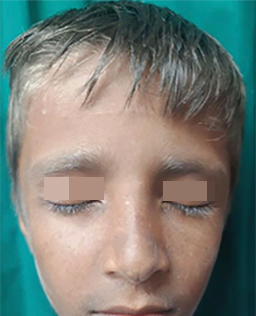
Case report. Two young brothers, aged 9 years (Patient 1) and 8 years (Patient 2), born to consanguineous parents presented with gray hair over the scalp and body since birth and dark pigmentation over the face since 4 years. Their developmental milestones were normal and immunized to date. There was no history of recurrent fever or respiratory tract infections. Their scholastic performance was on par with the children of the same age group. Cutaneous examination revealed gray hair over the body including scalp, eyebrows, eyelashes, forearms and legs, bronze tan pigmentation over face and neck. Trichoscopy of hair shaft showed uneven clusters of melanin aggregates in the medulla giving “road dividing line” appearance.
Discussion. Griscelli syndrome (GS) also known as “partial albinism with immunodeficiency” was first described by Griscelli and Siccardi in 1978. Most cases have been reported from Turkish and Mediterranean populations.
The three types of Griscelli syndrome are caused by mutations in different genes: Type 1 results from mutations in the MYO5A gene, type 2 is caused by mutations in the RAB27A gene, and type 3 results from mutations in the MLPH gene. As treatment, prognosis and genetic counselling differ to a great extent among various types, accurate genetic diagnosis early in life plays a crucial role.