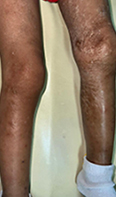
Deep circumscribed morphea in a 3-year-old child.
Downloads
DOI:
https://doi.org/10.26326/2281-9649.36.2.2913How to Cite
Abstract
Morphea, or localized scleroderma, is a rare inflammatory disorder characterized by fibrosis of the skin and underlying tissues. In pediatric patients, delayed diagnosis may lead to functional impairment and growth disturbances, particularly when deeper structures are involved. We report a case of a three-year-old boy who presented with progressive skin induration and hypopigmented macules on the left lower limb, along with hyperpigmented plaques on the abdomen. Over the course of one year, the lesions became firm and retracted, resulting in mild limb asymmetry. Histopathological examination revealed epidermal atrophy, dermal fibrosis, and lymphocytic infiltration. Laboratory evaluation showed elevated antinuclear antibodies and anti–double-stranded DNA levels, while magnetic resonance imaging demonstrated subcutaneous and muscle atrophy with a mild limb length discrepancy. Based on clinical, histological, and radiological findings, a diagnosis of deep circumscribed morphea was established. The patient was treated with systemic methotrexate in combination with topical emollients, leading to lesion softening and stabilization without further disease progression after six months of follow-up. This case highlights the importance of early recognition and appropriate systemic therapy in pediatric morphea to prevent long-term functional and growth-related complications.